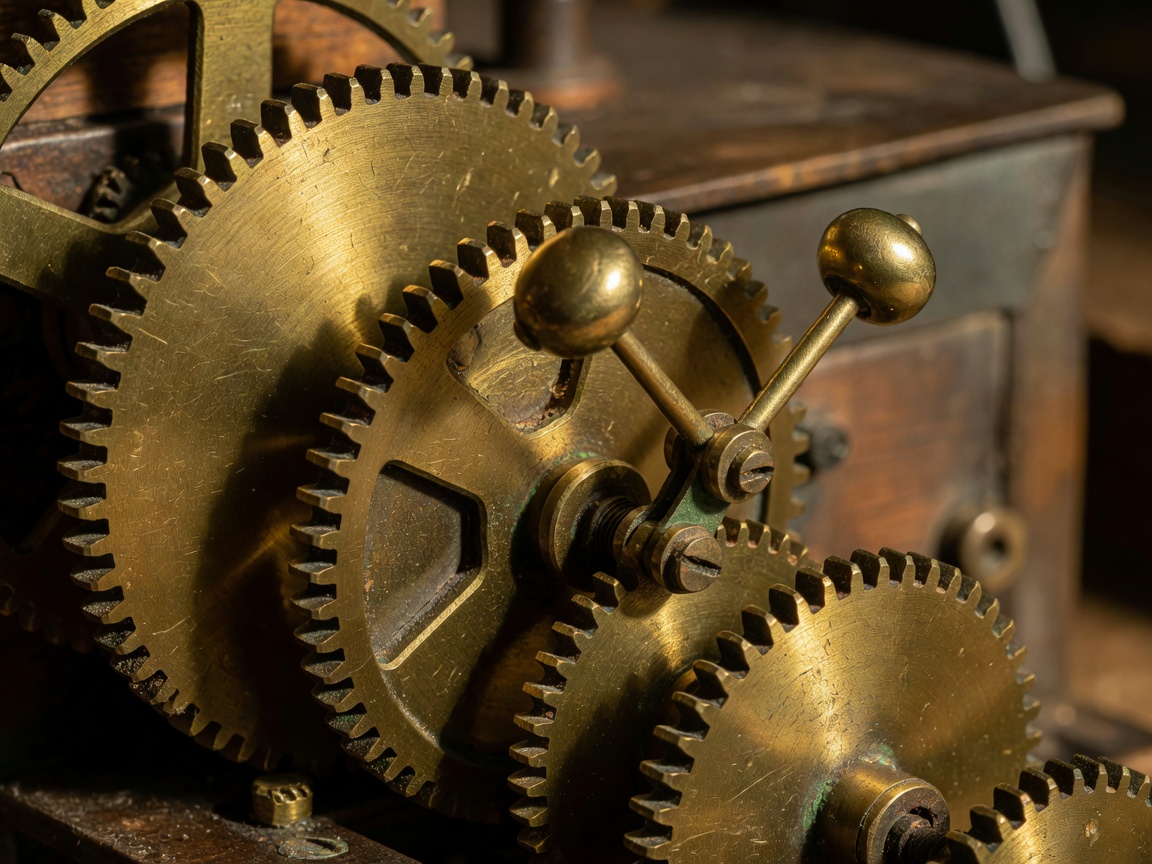
Beautiful objects invite attention. Their mechanisms reward it. We explain historical sound by showing what stores the information, what supplies energy and what vibrates.
Independent, not institutional
Rhythm Vault Trolley is an independent educational website about vintage music machines and historical sound technology. It is not a museum collection, dealer, restoration workshop or certification service.
We are not affiliated with the museums, archives, manufacturers or research projects mentioned in our articles. Links identify useful evidence and further reading, not endorsements or commercial partnerships.
The cabinet metaphor organizes ideas; it does not claim that we own the objects described.
A mechanism detail invites a functional question before an attribution: what work does each component do?
How we handle a historical claim
We favor named objects, institutional catalogs, primary patents and research that explains its methods. A date is more useful when its meaning is clear: application, patent, demonstration and commercial introduction are not interchangeable events.
Short explanations necessarily simplify. We flag important exceptions rather than treating one familiar mechanism as the model for an entire family. A pinned barrel, a paper roll and an audio groove may all move past a reader, but they do not contain the same kind of information.
What images can—and cannot—establish
Detail images illustrate parts and relationships. Unless an image is accompanied by a specific documented attribution, it should not be treated as evidence for a maker, year or provenance. Captions distinguish construction details from claims about individual artifacts.
Likewise, a polished case does not prove originality, and a running mechanism does not prove a historically faithful restoration. We encourage documentation of alterations and uncertainty.
Care comes before demonstration
These articles are explanations, not repair instructions. Stored spring energy, fragile materials and old electrical components can present serious risks. An instrument can deserve preservation even when it cannot safely be played.
Corrections belong in the cabinet
If you notice an error, send the page title, the sentence in question and a source that supports a correction. A collection number, patent reference or stable institutional link is especially helpful. Please separate direct observation from interpretation.
Cookies on this site We use necessary cookies to run the site and, with your consent, optional ones to measure visits. You can change this at any time. Read more