Before the roll: a barrel gives orders
Automatic instruments belong to a long history of clocks, organs and mechanical entertainments. In a barrel organ, pins or staples arranged on a rotating barrel operate a control mechanism that admits air to selected pipes. The barrel stores musical instructions; it does not contain the sound itself. A crank may turn the barrel and operate bellows through linked machinery, giving one human gesture several mechanical consequences.
Timing follows rotation, so cranking speed matters. Wind supply matters too: pipes need air delivered under suitable conditions if they are to speak reliably. The instrument’s apparent simplicity hides a coordination problem between the musical program and the energy needed to execute it. A jerky performance can reflect the operator, the mechanism or the condition of the wind system, rather than an inherent property of “old music.”
What a paper roll actually tells the instrument
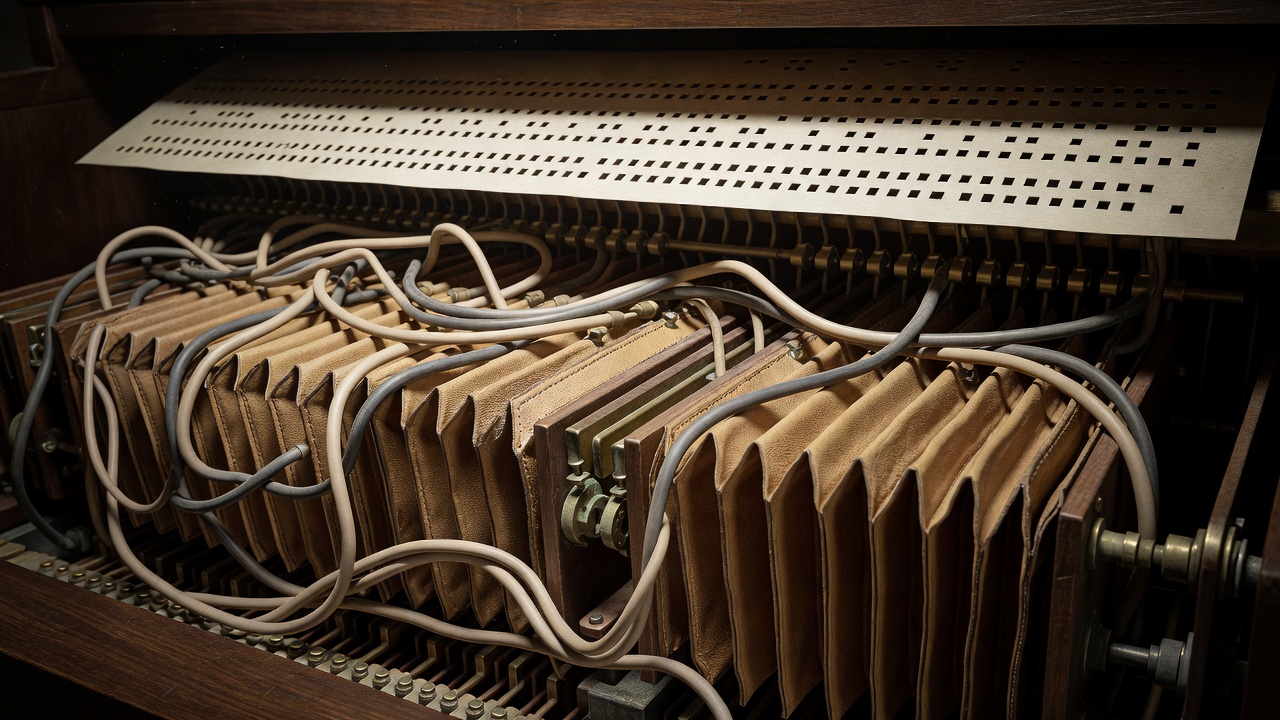
In a typical pneumatic player piano, a perforated paper roll moves across a tracker bar containing small openings. When a hole in the paper meets an opening, the resulting change in an air circuit triggers a sequence of valves and pneumatic movements. This eventually operates part of the piano action. The paper does not physically push each key with enough force to play a note; it provides control signals to a powered system.
Read a roll as a spatial arrangement with a direction of travel. The channel across the roll corresponds to a control function, often a note, while the lengthwise arrangement organizes time. Hole length can help determine how long an action is maintained, but paper, valves, action regulation and musical acoustics all mediate the final result. Different formats have different channel assignments and conventions. A roll that fits physically is not necessarily compatible.
The person has not disappeared
The Aeolian Company’s Pianola, introduced in 1897, is a useful landmark in the player-piano story. Early external players could operate an ordinary piano keyboard; later instruments integrated the apparatus into the piano. In many foot-powered systems the operator supplied energy by pedaling and shaped the result through tempo and expression controls. Calling every such performance “automatic” can conceal substantial human participation.
Reproducing systems pursued a different promise: preserving aspects of a particular pianist’s performance through encoded expression as well as note events. Welte-Mignon, introduced in 1904, is a prominent example. These rolls are invaluable historical documents, but they are not transparent windows onto a recording session. Encoding, editing, calibration and the playback instrument affect the outcome. A modern transfer also adds its own acoustic and recording conditions.
When one cabinet stands in for an ensemble
An orchestrion combines several instrumental resources in one machine, sometimes including pipes, percussion and string mechanisms. The term covers varied designs rather than one standardized internal arrangement. A roll, barrel or other program coordinates events; bellows, springs or motors provide energy; individual sound-producing components retain their own physical requirements. A large cabinet can therefore contain multiple technical systems with different maintenance needs.
Manufacturers such as M. Welte & Söhne and Hupfeld worked in a commercial world of restaurants, public entertainment and domestic music. These machines could fill a room without hiring an ensemble for every performance, but their repertory and voicing were deliberately arranged. A machine’s rendering of an orchestral work is an adaptation shaped by available resources, not a neutral copy of an orchestra.
Listen for action, not just melody
At a supervised demonstration, notice whether tempo changes continuously, how sustained notes behave and whether percussion articulates independently of the melodic line. Ask what supplies the wind and what moves the program. A quiet electrical motor behind a restored instrument does not necessarily mean its musical instructions have become electronic. Conversely, a modern digital control retrofit can change the information path while leaving original acoustic pipes or strings in use.
Conservation descriptions should identify such interventions clearly. Replacing perished pneumatic cloth may restore function but changes material evidence. Retaining an old roll while replacing its control apparatus preserves one part of the historical chain and not another. Neither choice can be judged responsibly from a short video alone; documentation and the instrument’s intended use matter.
Construction note: suction is not an absence of force
In a suction-based player action, atmospheric pressure acts against a lower-pressure region to move a pneumatic element. “Vacuum-powered” is convenient shorthand, but pressure difference is the working principle.
Evidence drawer
- The Musical Museum, Brentford — self-playing instruments, including reproducing pianos.
- Museum Speelklok, Utrecht — organs and automatic musical instruments.
- Science Museum Group: player piano — object-level comparison and historical descriptions.