First, make sound visible
Édouard-Léon Scott de Martinville patented the phonautograph in 1857. Its purpose was to trace sound, not to play it back. Sound entered a collecting structure and moved a membrane; an attached stylus inscribed a line on a prepared surface. The resulting phonautogram was a visible record of vibration. Calling it a phonograph would blur an important distinction between drawing a sound trace and engineering a system that can reproduce it.
Researchers associated with First Sounds later recovered audible information from surviving traces through optical analysis and digital processing. Scott’s 1860 trace of “Au clair de la lune” is particularly well known. That modern achievement does not mean the original machine had a playback function. It shows that an artifact can preserve information its maker had no practical means of hearing again.
Then, make a trace speak
Thomas Edison’s 1877 phonograph joined recording and reproduction in a functioning system. In the early tinfoil design, a stylus acted on foil wrapped around a grooved cylinder. During playback, the recorded surface drove a stylus and diaphragm, turning mechanical movement back into airborne sound. Later cylinder technologies used other materials and more developed recording methods; a tinfoil demonstration and a commercial wax-cylinder machine should not be treated as the same apparatus.
Alexander Graham Bell, Chichester Bell and Charles Sumner Tainter contributed to the Graphophone developments associated with the Volta Laboratory. Their work forms part of a competitive, interconnected history rather than a single inventor’s uninterrupted march. Patent dates, prototypes, demonstrations and successful commercial products answer different historical questions. A precise account says which milestone it means.
Recording before microphones
In an acoustic recording system, performers supplied enough sound energy to move a diaphragm through a horn. The diaphragm’s motion drove a cutting stylus. There was no microphone and electrical amplifier in this chain. Placement, instrumentation and performance style were adjusted to the machine’s response, which did not capture all frequencies or sound levels equally well.
Consequently, an early recording is both a performance document and the product of a technical encounter. A singer’s distance from the horn, the balance of instruments and the recorder’s mechanical behavior all shaped the trace. Surface noise and limited bandwidth are not the only differences from modern recording. The musicians may have changed how they performed because they were addressing the recording system rather than a concert audience.
Cylinder, disc and direction of movement
Emile Berliner’s gramophone work, including his 1887 patent, is central to the development of disc recording. Many familiar disc records carry lateral modulation: the groove moves from side to side. Many cylinder systems use vertical, or hill-and-dale, modulation. These are useful starting points, not universal rules. Some discs also used vertical recording, and format identification must rest on more than the shape of the carrier.
Disc manufacture supported duplication through processes involving masters and stampers, contributing to the growth of a large recorded-music industry. Yet cylinders also developed commercial duplication methods. Avoid the tidy story that one format was always unique and the other always mass-produced. Materials, manufacturing processes and business practices changed over time, and the history differs across manufacturers and markets.
The playback machine is part of the evidence
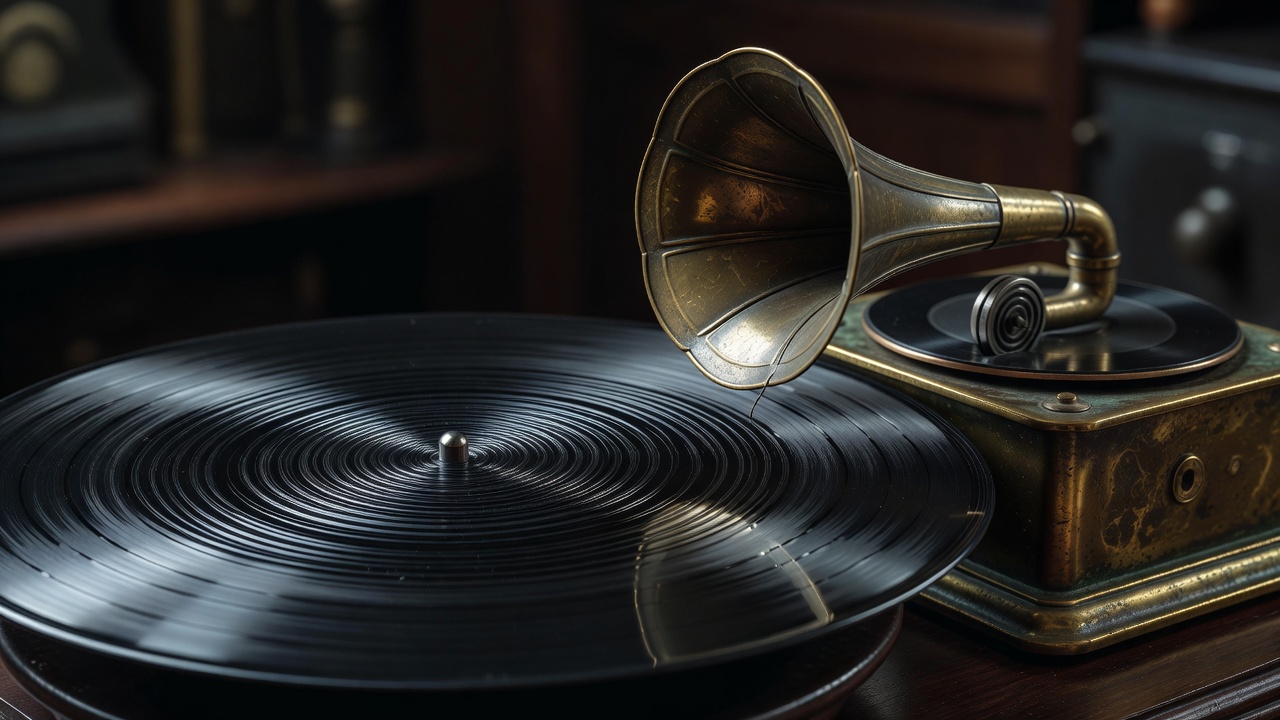
A mechanical reproducer follows a groove with a stylus and transfers its movement to a diaphragm. A horn couples the diaphragm’s motion to the air more effectively; it does not provide electrical amplification. Meanwhile, a drive system must keep the carrier moving at an appropriate speed. Speed errors alter both pitch and duration, so a persuasive-sounding transfer is not automatically a historically correct one.
Do not assume that every old disc should run at exactly 78 revolutions per minute, or that one needle suits every recording. Early speeds varied, and groove dimensions, modulation and materials require compatible equipment. Playing a fragile or unidentified carrier can permanently damage it. Archival transfer work may use specialized styli, careful speed research and non-contact methods where appropriate. Good preservation begins with identification, not with dropping a needle into a groove.
Construction note: why a horn is not an electronic amplifier
A horn is an acoustic coupling device. It helps transfer available vibrational energy into the surrounding air, but it does not add energy from an electrical power supply.
Evidence drawer
- First Sounds — research and audio relating to early sound traces.
- Library of Congress: Edison collection — primary material and historical essays.
- Library of Congress: Emile Berliner — documents and recordings.
- Thomas Edison National Historical Park — laboratory and invention context.