Where the tune lives
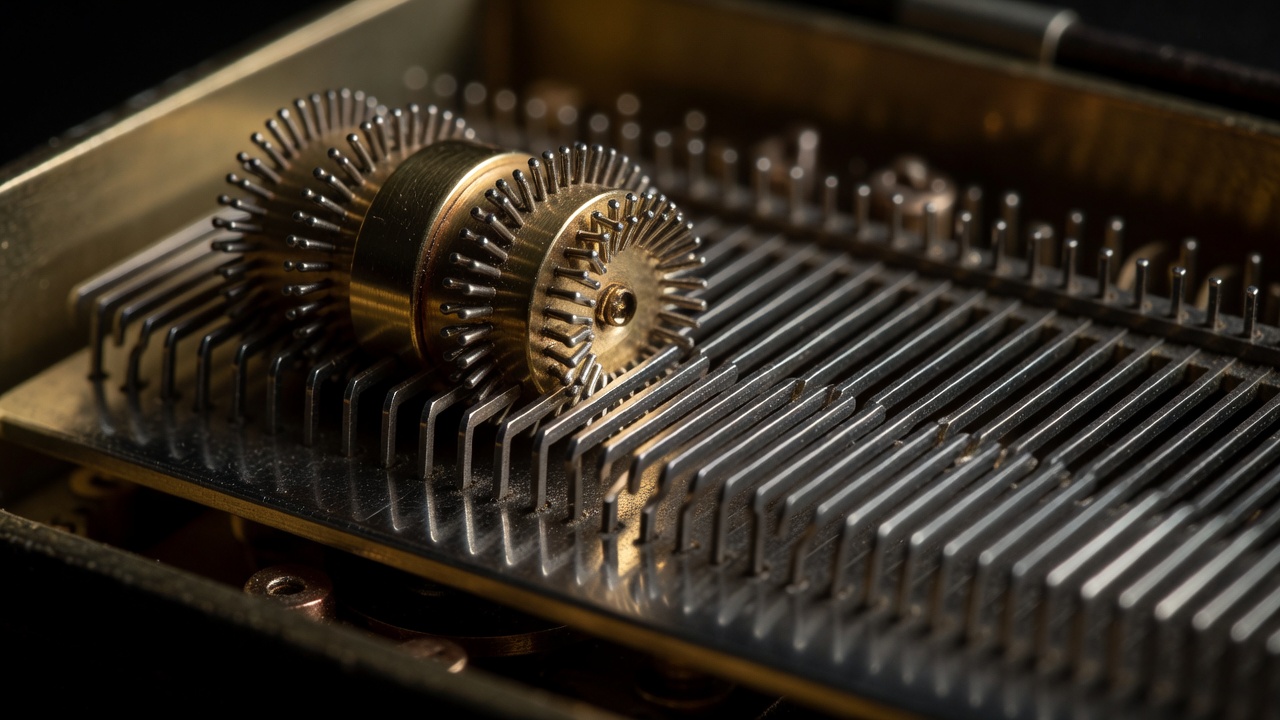
A cylinder music box stores a sequence in the placement of tiny metal pins. As the cylinder revolves, a pin catches a selected steel tooth, bends it slightly and releases it. The tooth then vibrates at a pitch determined by its physical properties. In simplified terms, position along the cylinder chooses the note, while angular position determines when it occurs. Closely spaced events sound close together in time, provided the cylinder turns at a reasonably steady speed.
That distinction matters when describing the object. A pinned cylinder is not a sound recording. It contains instructions for making a new acoustic performance whenever the mechanism runs. It does not retain the voice of a particular singer or the complex pressure changes of an orchestral room. Its closest conceptual relative is a musical score executed by machinery, though the pinning can specify details a printed score leaves to a performer.
From winding key to measured motion
Many familiar examples use a wound mainspring, enclosed in a barrel, to drive a train of gears. The spring’s stored energy must be delivered at a usable speed. A governor provides regulation, often using aerodynamic resistance in a rapidly rotating fan. Without effective regulation, the sequence can run too quickly and damage may follow. The governor is therefore part of the musical system, not merely an accessory attached to it.
Listen for the relationship between tempo and mechanics rather than expecting perfect modern timing. Friction, wear, lubrication condition and the changing delivery of a spring can influence operation. These observations are diagnostic clues for a specialist, not an invitation to experiment. Turning a governor by hand or bypassing a stop can put forces through delicate parts in ways the design never intended.
Why the comb sings
The comb is a set of tuned steel tongues or teeth, usually formed as part of a common metal base. Tooth length, thickness and added mass affect pitch; the tuning work can be extremely precise. A pin must release the tooth cleanly so it can ring. The base, bedplate and cabinet participate in transmitting vibration to the surrounding air. A handsome case is thus both furniture and part of the instrument’s acoustic setting.
Larger mechanisms may use multiple combs or tooth arrangements to create fuller textures and repeated notes. Dampers can help control unwanted interference when a vibrating tooth is engaged again. These refinements explain why two boxes playing the same melody can sound strikingly different. Musical quality is not reducible to the number of tunes printed on a label or the apparent size of the cylinder.
A careful historical starting point
Antoine Favre, a Genevan watchmaker, is commonly associated with a 1796 musical mechanism using tuned steel elements in a watch-sized setting. This is a useful milestone, not a claim that mechanically organized music began that year. Earlier clock and organ traditions already used programmed motion to operate sound-producing parts. During the nineteenth century, Swiss makers developed increasingly ambitious cylinder instruments, with Sainte-Croix becoming an important center of manufacture.
Late nineteenth-century disc systems changed how owners obtained repertory. Makers such as Symphonion, Polyphon and Regina offered instruments using interchangeable discs. Depending on the system, projections on a disc engage intermediate components such as star wheels, which in turn pluck comb teeth. A disc is therefore not automatically a direct mechanical substitute for a cylinder: the transmission path deserves its own inspection. Easier exchange helped turn the instrument into a platform for a collection of tunes.
Read the object before touching it
Begin with documentation: overall photographs, inscriptions, tune sheets and visible serial numbers, recorded without dismantling. A paper label can be replaced or associated with the wrong mechanism, so treat it as evidence to compare rather than a final verdict. Separate observations from conclusions: “missing tooth visible” is stronger than “needs a new comb,” which presupposes a repair decision.
Do not wind a mechanism that resists, run a box with a damaged governor or apply household oil as a general cure. Old lubricants, hidden cracks and spring damage call for qualified assessment. Preserving an instrument sometimes means not playing it. A silent but well-documented original can retain evidence that an enthusiastic, poorly recorded repair would erase.
Construction note: why repeated notes are difficult
A tooth may still be vibrating when the next pin reaches it. Pin spacing, duplicated notes and damping arrangements can help manage that interaction. Exact solutions vary by maker and mechanism.
Evidence drawer
- Museum Speelklok — self-playing instruments and their historical interpretation.
- Science Museum Group: musical boxes — compare cataloged objects and construction descriptions.
- Centre International de la Mécanique d’Art — Sainte-Croix’s mechanical arts context.