Glass harmonica: friction with a continuous voice
Benjamin Franklin developed his glass armonica in 1761 after encountering the musical use of rubbed glass rims. Rather than arranging separate drinking glasses on a table, his instrument mounted a series of graduated glass bowls on a horizontal spindle. A treadle rotated the assembly, and the performer touched the rims with moistened fingers. Friction sustained vibration in the glass, allowing connected phrases and combinations of notes.
The instrument is mechanical in its rotating support and drive, but it is not a self-playing music machine. There is no cylinder prescribing the composition. The player supplies touch, timing and musical decisions. That distinction prevents a picturesque object from being placed in the wrong technical category. The mechanism supports performance; it does not replace the performer’s selection of notes.
Composers including Wolfgang Amadeus Mozart wrote for the instrument. Its unusual timbre attracted both fascination and elaborate historical speculation. Stories about mysterious effects on listeners should be treated as cultural evidence, not accepted as medical explanations. The physical account begins with friction, resonant glass and the performer’s control of contact.
Aeolian harp: an instrument without a fixed program
An aeolian harp allows moving air to excite stretched strings. Wind flowing across a string can produce alternating forces that sustain vibration under suitable conditions. The resulting sound depends on wind behavior, string properties and the instrument’s construction. Upper partials can become prominent, creating a changing texture rather than a straightforward melody played at will.
Athanasius Kircher discussed an aeolian instrument in his seventeenth-century work, and the harp later became associated with Romantic ideas about nature and inspiration. Yet “played by nature” is only the beginning of an explanation. A maker still chooses materials, tensions, lengths and placement. The environment participates in the performance, but the object establishes the conditions under which that participation becomes audible.
Singing birds: a tiny theater of coordinated motion
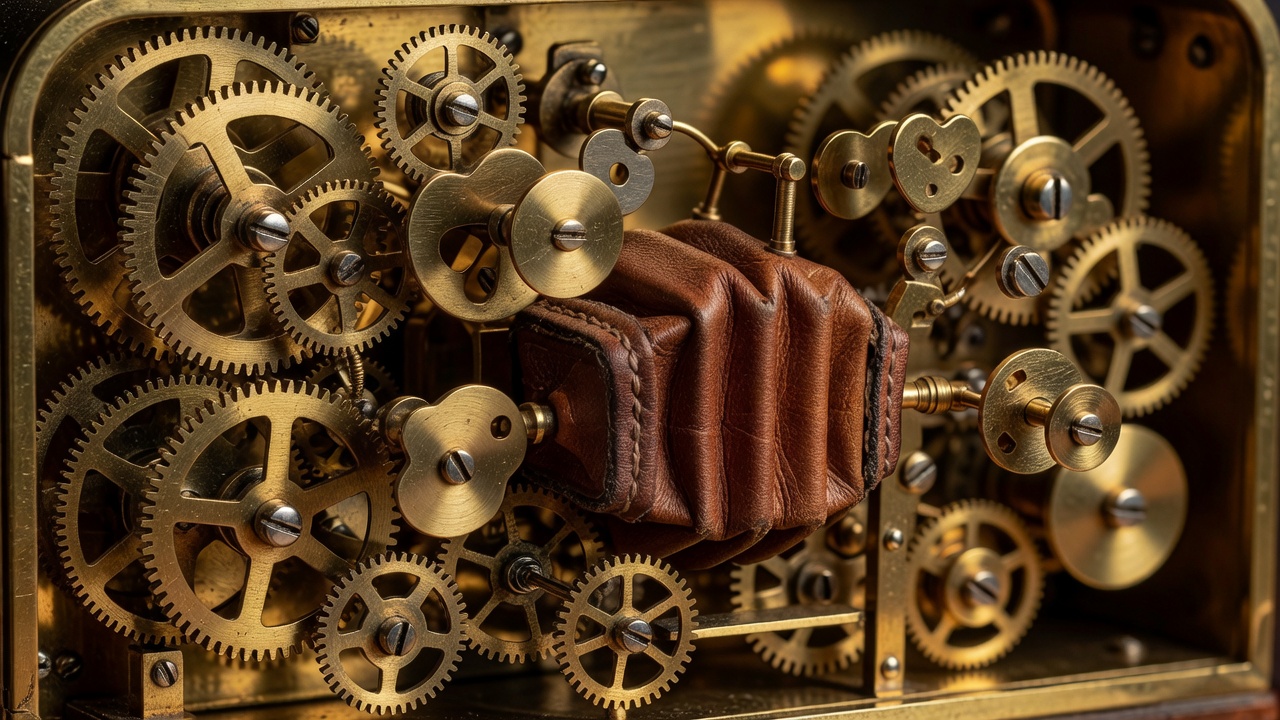
Singing-bird automata combine visible animation with an artificial voice. In many designs, bellows provide air to a whistle, while mechanisms vary its effective acoustic behavior to create changing pitches and birdlike phrases. Cams and linkages coordinate the sound with movements such as an opening beak, turning body or fluttering wings. The exact arrangement differs, so one example should not be used as a diagram for every maker.
Pierre Jaquet-Droz and Henri Maillardet belong to the wider history of automata, while the Rochat and Bruguier workshops are important names in singing-bird mechanisms. Attribution requires close evidence: signatures, construction, provenance and comparison with documented objects. A convincing bird performance is not a reliable maker’s mark. Nor should a miniature case encourage casual handling; very small components can transmit considerable spring force.
Telharmonium: rotating machinery enters electrical music
Thaddeus Cahill’s telharmonium, associated with an 1897 patent and public operation in New York in 1906, generated electrical musical signals using rotating machinery. Different frequency components could be combined to shape tones, anticipating principles important in later electrical organs. The apparatus was enormous compared with a domestic music box, and distribution through telephone infrastructure formed part of its ambition.
This is not acoustic sound stored in a groove, and it is not a pinned program plucking steel. Electrical generation is central to the instrument’s voice. Mechanical rotation remains important, but the sound reaches listeners through electrically driven receiving devices. The telharmonium demonstrates why “mechanical” and “electrical” should be used to describe particular stages of a system rather than as labels that explain everything at once.
Theremin: gesture without contact
Developed by Lev Termen, known internationally as Léon Theremin, around 1920, the theremin offers a different electrical approach. The performer’s hands alter capacitance near antennas, influencing circuitry that controls pitch and loudness. In the classic pitch system, interaction between high-frequency oscillations produces an audible difference frequency. The instrument neither reads a paper roll nor waits for a plucked string to ring.
Its theatrical appearance can distract from the player’s skill. Without fixed keys or frets, accurate intonation depends on controlled movement and listening. Like the glass harmonica, it is an unusual instrument rather than an automatic substitute for a musician. Comparing the two reveals a useful continuity: inventive mechanisms create new relationships between a human gesture and a sustained tone.
Construction note: an animated beak does not necessarily make the sound
The visible beak can be a synchronized theatrical element while a separate whistle inside produces the voice. Always distinguish what an audience sees from what actually vibrates.
Evidence drawer
- The Franklin Institute — Franklin’s inventions and scientific context.
- The Metropolitan Museum of Art: glass harmonica search — documented musical instruments.
- Science Museum Group: theremin — object records for electronic instruments.
- Cahill’s US Patent 580035 — primary technical evidence for electrical music generation.